

Industrial Communication
Industrial Real-Time Networking.
TSN, OPC UA FX, and DetNet
Industrial real-time networking for Linux can be achieved by combining Time-Sensitive Networking (TSN), OPC UA FX, and Deterministic Networking (DetNet). They provide together an open communication stack for industrial control, edge computing, and converged OT/IT networks.
Industrial automation has traditionally relied on proprietary fieldbus technologies such as EtherCAT and PROFIBUS. These systems provide deterministic communication but lock deployments into proprietary vendor protocols, and some, like PROFIBUS, require dedicated cabling separate from standard IT infrastructure.
Time-Sensitive Networking (TSN) extends Ethernet (IEEE 802.1Q) with deterministic timing and reliability features, industrial control applications normally require. Mainline Linux supports the major parts of TSN through the kernel networking subsystem and user-space tools without requiring out-of-tree patches, covering the majority of TSN-capable hardware.
With TSN, OT real-time traffic and conventional IT traffic share the same Ethernet infrastructure. Non-real-time applications use the full Linux networking stack and its broad ecosystem while the TSN ensures that this traffic does not affect the timing of latency-sensitive flows.
For participants in a TSN deployment, interoperability across vendors is more important than any single implementation’s performance advantage. TSN’s value is the ecosystem: open standards that allow equipment from different manufacturers to share a network without vendor lock-in.
RTC-Testbench
RTC-Testbench validates real-time and non-real-time traffic over TSN and PREEMPT_RT, using protocols like PROFINET and OPC UA PubSub as workloads — and benchmarks the performance cost of security measures such as authentication and encryption, which matters more each year under the EU Cyber Resilience Act (CRA).
Two parts: reference generates and checks RT and non-RT traffic; mirror reflects it back. Jitter and latency are visible live in a Grafana dashboard. Not a TSN conformance tool — an evaluation tool for real-world deployments, vendor-independent, built entirely on mainline Linux utilities.
Linutronix maintains the project, backed by sponsors including Phoenix Contact, Intel, and Siemens.
OPC UA on Linux
OPC UA (IEC 62541) is a vendor-neutral application-layer protocol for IT and OT communication in industrial systems.
PubSub
Publishers send process data cyclically or on events to multiple subscribers without a point-to-point connection. Over TSN, OPC UA PubSub provides deterministic delivery for field-level control applications.
OPC UA FX
OPC UA FX (Field eXchange) is the field-level extension from the OPC Foundation Field Level Communications Initiative. It replaces proprietary fieldbus protocols with a TSN-based open standard and includes a connection manager for coordinated real-time communication between controllers.
Linux provides different socket APIs for TSN applications, each with different latency tradeoffs:
open62541
open62541 is a widely used open-source C implementation of OPC UA. Linutronix contributes to open62541, including the Security Key Service (SKS) for PubSub encryption key distribution and Avahi integration for mDNS-based server discovery.
OPC UA PubSub over TSN is deployed in production. OPC UA FX connection manager support is not yet complete in open62541.
Deterministic Networking (DetNet)
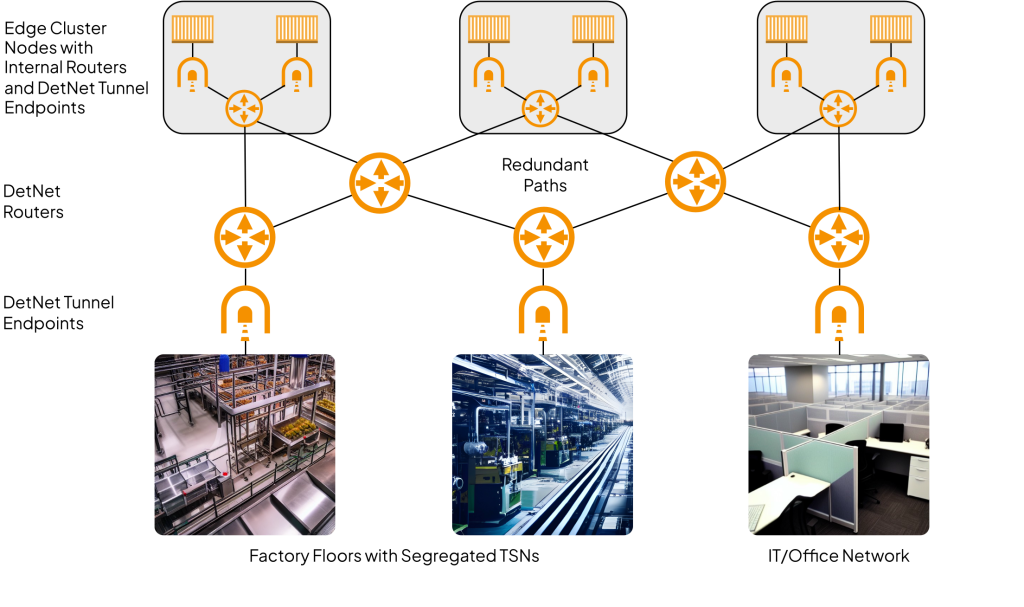
TSN works well within a single factory floor, but does not scale across industrial parks or multi-building facilities: without Layer 3 routing between separate Layer 2 segments, broadcast storms degrade performance and security becomes hard to ensure — the same constraint energy distribution networks and telecom providers face. DetNet, standardized by the IETF, extends TSN’s Layer 2 guarantees to Layer 3, building directly on TSN concepts (RFC 9023).
Tunneling
IPv6 or MPLS pseudowires encapsulate Ethernet frames across Layer 3 hops. The frame including its VLAN mapping is reconstructed at the egress tunnel endpoint, preserving traffic-class assignments end-to-end.
Traffic replication
VLAN IDs are assigned per domain and mapped to distinct DetNet flows at segment boundaries.
Flows are duplicated across redundant paths, so a failed cable or switch does not interrupt real-time communication.
Domain isolation
detnetctl
detnetctl configures a Linux PC as a DetNet router or edge cluster node on standard hardware — replacing manual TAPRIO qdisc setup with YAML or NETCONF/YANG configuration, using standardized data models compatible with managed switches.
When multiple containers share a node, detnetctl assigns each application’s traffic to a separate queue. Even unrelated traffic in a real-time queue causes packet loss and latency spikes; detnetctl routes each application’s frames to the correct queue without changing the application.
The Complete Open Communication Stack
TSN, OPC UA FX, and DetNet carry real-time OT and conventional IT traffic over shared Ethernet infrastructure, removing dedicated fieldbus cabling and reducing vendor lock-in.
LayerTechnologyUsed for
ApplicationOPC UA FXVendor-neutral semantic data model
MessagingOPC UA PubSubCyclic and event-driven messaging over TSN
Data linkTSN (IEEE 802.1Q)Deterministic latency, sub-microsecond sync
NetworkDetNet (IETF)Deterministic L3 routing across TSN segments
Work with us on your industrial communication solution
From hardware timestamping to converged architectures — the same team that builds these technologies upstream.
PTP
Driver development and user-space integration for hardware timestamping; grandmaster and boundary clock configuration with linuxptp.
Converged architecture
Combined OT and IT traffic design on shared Ethernet — TSN bring-up, DetNet deployment with detnetctl, and real-time, security and update integration.
Switch and NIC support
Driver development for switchdev and DSA-based network switches, plus bugfixing across the networking stack.
OPC UA FX
open62541 integration, connection manager development, and PubSub security.
We also offer training courses on real-time networking and TSN.
Ready to converge your OT and IT networks?