

Threat modeling, architecture review, compliance support.
Security
Embedded Linux Security.
Security from the Beginning for Embedded Linux
Embedded Linux systems are increasingly exposed to remote attacks, supply chain risks, and strict regulatory requirements such as the EU Cyber Resilience Act (CRA). Securing these systems requires more than isolated hardening techniques. It demands a complete security architecture that spans hardware trust anchors, kernel enforcement mechanisms, runtime protection, and secure lifecycle management.
This includes secure boot chains, mandatory access control, filesystem integrity, cryptographic key protection, and secure update mechanisms, implemented as a coherent system rather than individual features.
Linutronix delivers embedded Linux security across the full stack, from Trusted Platform Modules (TPM) and Hardware Security Modules (HSM) to SELinux policies and cryptographically verified OTA updates.
Why Embedded Linux Security Matters
Embedded Linux security is critical for systems in industrial control, medical devices, automotive, and critical infrastructure that face special security requirements:
10+ year lifecycles Continuous security updates required throughout extended deployment periods.
Network connectivityIoT/IIoT connections expose devices to remote attacks
CRA compliance Mandatory for European Union market access by December 2027
Resource constraintsEfficient security solutions for embedded platforms
Supply chainVulnerable third-party components require SBOM tracking
Each embedded system requires a security architecture matched to its threat model, hardware platform, and regulatory requirements.
Common Attack Vectors in Embedded Systems
Understanding embedded Linux security threats drives effective technology selection:
ATTACK VECTORRISKMITIGATION
Unpatched vulnerabilitiesKnown CVEs in kernel/librariesAutomated updates + CVE tracking
Default credentialsFactory passwords on servicesForced password change + key auth
Network exposureUnnecessary open portsFirewall + service minimization
Debug interfacesUART/JTAG in productionDisable or protect debug access
Supply chainCompromised componentsSBOM + dependency scanning
No update pathCannot patch deployed devicesSecure OTA update mechanism
Core Embedded Linux Security Technologies
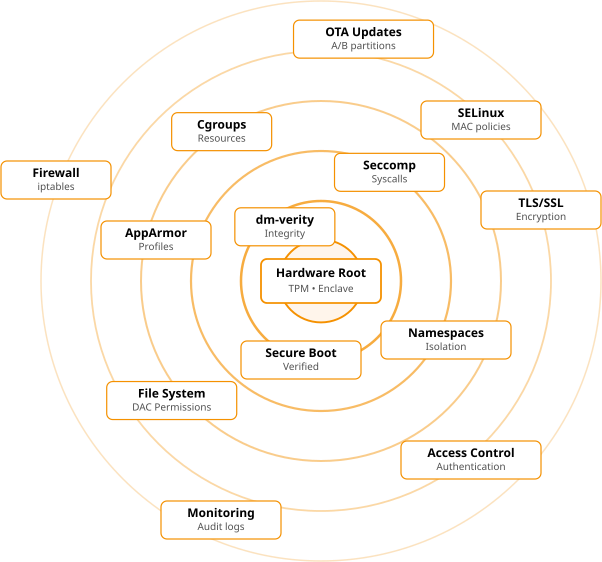
Implementing embedded Linux security requires technologies across different technical areas based on upstream kernel frameworks and industry-standard tools. The following is a non exhaustive list of a Defense-in-Depth Strategy.
Secure System Design
Security by design means building protection into the architecture from the beginning rather than adding security modules afterward. This fundamental approach starts before writing a single line of code and involves:
- Threat Modeling and Risk Assessment
- Secure Defaults Configuration
- Minimal Attack Surface
- Defense-in-Depth Architecture
Process Isolation & Access Control
Modern Linux systems provide kernel-level mechanisms for isolating processes and controlling resources in a fine-grained manner.
Linux Capabilities for Fine-Grained Privileges
The Linux kernel divides traditional root privileges into over 40 different capabilities that can be granted individually. Instead of running processes as full root with unrestricted access, one can grant only specific capabilities like CAP_NET_BIND_SERVICE (bind to privileged ports) or CAP_SYS_TIME (set system clock). This granular control dramatically reduces the impact of compromised processes.
Namespaces for Process Isolation
Linux namespaces create isolated environments where processes cannot see or interact with resources outside their namespace. For example:
- PID namespaces isolate process IDs
- Mount namespaces provide separate filesystem hierarchies
- Network namespaces create isolated network stacks
Control Groups for Resource Management
Cgroups limit and account for resource consumption by process groups, which limits exhaustion attacks. Beyond security, cgroups prevent any single process or container from consuming all CPU, memory, disk I/O, or network bandwidth.
Mandatory Access Control (MAC) Frameworks
SELinux or AppArmor enforce mandatory security policies that unlike discretionary access control, where file owners set permissions, are system-wide and immutable at runtime. An attacker who compromises a process is still constrained by that process’s MAC context regardless of the user ID it runs under.
Secure Boot
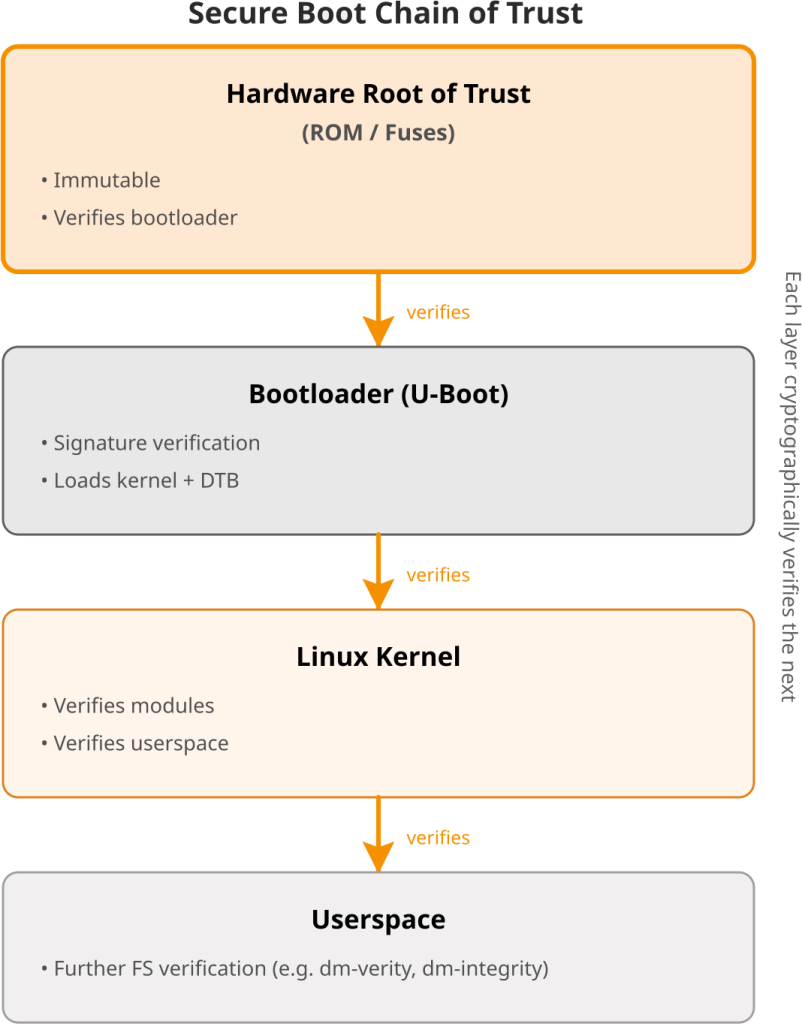
Secure boot provides a chain of trust from the moment power is on, ensuring only authenticated software executes at every stage from bootloader through kernel to userspace applications.
Hardware Root of Trust
Security starts with immutable code stored in processor ROM or one-time-programmable fuses. This boot ROM cannot be modified after manufacturing, providing an anchor of trust. The ROM contains cryptographic keys and code to verify the next boot stage.
Bootloader Verification
The hardware root of trust verifies the bootloader’s cryptographic signature before execution. U-Boot, the most widely used embedded bootloader, supports verified boot using FIT (Flattened Image Tree) or UKI (Unified Kernel Image) images containing kernel, device tree, and signatures.
Kernel and Module Signing
The bootloader verifies the kernel image before starting Linux. Once running, the kernel enforces signature verification on loadable kernel modules, preventing unauthorized kernel code from executing.
Userspace
Userspace is protected to prevent tampering with applications, libraries, and configuration files.
dm-verity provides integrity checking for block devices, typically used to protect read-only filesystems like the root filesystem. For writable filesystems, dm-integrity can be utilized.
Network Security
Embedded Linux network security protects communications and limits exposure while maintaining necessary connectivity for remote access, monitoring, and cloud integration.
Firewall Configuration and Packet Filtering
iptables and its modern replacement nftables control network traffic at the kernel level. Firewall rules filter packets based on source and destination addresses, ports, protocols, connection state, and packet contents. Default-deny policies block all traffic except explicitly permitted connections. Connection tracking (conntrack) enables stateful filtering that understands TCP sessions and related connections. Rate limiting prevents network flood attacks.
TLS/SSL for Application Layer Security
Transport Layer Security encrypts application protocols including HTTPS, MQTT, AMQP, and custom protocols. Certificate management ensures devices authenticate themselves to cloud services and verify server identity. Certificate pinning prevents man-in-the-middle attacks. Perfect forward secrecy (PFS) protects past communications even if keys are later compromised. Mutual TLS authentication requires both client and server certificates.
Network Segmentation and Isolation
Separate network segments isolate different functional areas using VLANs or physical separation. Critical control networks remain isolated from general-purpose networks. DMZ(Demilitarized Zone) networks isolate internet-facing services from internal systems. Network bridges and routing policies control traffic between segments.
Cryptographic Key Management
Secure systems depend on strong protection of cryptographic keys used for boot verification, encryption, and authentication.
Hardware-Based Key Storage
Trusted Platform Modules (TPM) and secure elements store keys in protected hardware, preventing extraction even if the system is compromised.
Key Usage and Isolation
Keys should never be exposed in userspace memory. Cryptographic operations (signing, decryption) are performed inside secure hardware or isolated environments.
Key Lifecycle Management
Secure handling includes:
- Hardware-based key generation
- Controlled provisioning during manufacturing
- Regular key rotation where applicable
- Secure deletion at end of life
Secure Updates & Lifecycle
Embedded systems require secure update mechanisms throughout the device’s lifetime while protecting against attacks during the update process itself.
IGLOS – Pre-Integrated Embedded Linux Security Platform
First embedded Linux platform certified to IEC 62443 SL2
Instead of integrating and maintaining all security mechanisms individually, a pre-integrated platform can significantly reduce development effort and time to compliance.
IGLOS (Industrial Grade Linux Operating System) is a Debian-based embedded Linux distribution that combines the security technologies described above into a production-ready platform aligned with CRA requirements.
INTEGRATED SECURITY MECHANISMS
- Secure Boot
- Verified boot chain with TPM 2.0 support
- Mandatory Access Control
- Predefined AppArmor policies
- Secure Updates
- A/B partitioning with rollback protection
- SBOM Generation
- CycloneDX format
- Vulnerability Management
- Continuous CVE tracking
COMPLIANCE & CERTIFICATION CONTEXT
- Designed with IEC 62443 requirements in mind
- Supports CRA (Cyber Resilience Act) compliance workflows
- Developed under monitored quality processes (e.g. TÜV SÜD)
- Based on Debian for long-term maintainability
Rather than starting from a minimal Linux system and integrating security step by step, IGLOS provides a structured and validated baseline that can be adapted to specific product requirements.
Work with us on Embedded Linux Security
We work with you on security architecture, integration, and certification for your embedded project. If you have specific requirements around CRA compliance, IEC 62443, or a particular hardware platform, get in touch.
Consulting
Implementation
Secure boot, MAC policies, OTA update integration and security hardening
Training
Hands-on courses for your engineering team.
Ready to secure your embedded systems?